Why Learn Gemara? One Reason Among Many.
Charles wrestled with a monster of a Tosfot. At its heart: How do you balance marriage and Torah learning?
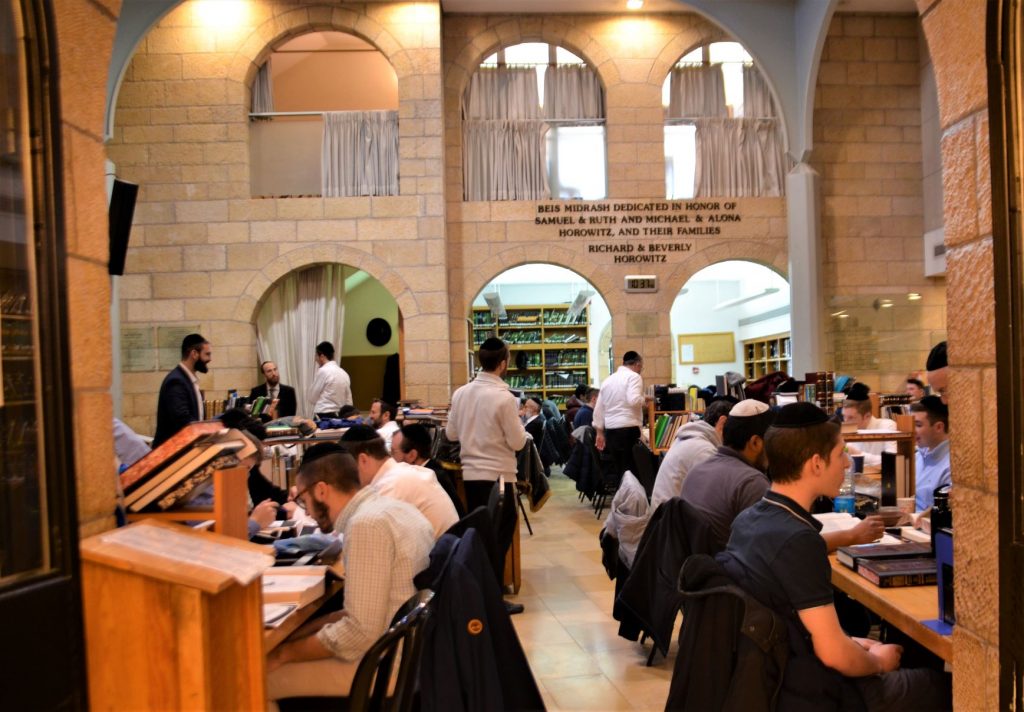
Beneath the yeshiva’s golden Jerusalem-stone arch, two Amoraim seemed to rise from the daf, offering conflicting paths. Rashi explained them. Rabbeinu Tam challenged Rashi. The search for truth stretched across an entire amud of Gemara.
As we unpacked it, I stopped him.
“Charles, you’ve got great energy. What’s driving you today? It’s a long, tough Tosfot, but you’re still going strong!”
He thought for a moment.
“Maybe it’s that last message Rav Zinkin sent us.”
Rav Zinkin, his maggid shiur, was overseas. He told his students how much chizuk their learning gave him and challenged them to step up their learning.
“Why does it mean so much to Rav Zinkin that you’re going the extra mile?” I asked.
“Because he puts so much into us and he sees we’re taking it seriously.”
“Sure, that would make any teacher or professor happy. But Rav Zinkin says your learning gives him chizuk. Why davka chizuk?”
Charles thought for a moment.
“Because it’s something I’ll pass on.”
The Acharon Acharon
Charles’s answer reminded me of an earlier morning when we were sorting out who was who in the sugya: the Amoraim, Rashi and Tosfot, the other Rishonim, and the Acharonim.
At the end, I asked Charles, “And what does that make you?”
He joked, “The Acharon Acharon!”
Charles wasn’t an Acharon. But he was joining a conversation centuries old. Rav Zinkin was part of it. Now Charles was too.
And Charles would pass on more than his rebbe’s explanations. He was learning how Rav Zinkin thinks. How he asks questions, tackles difficulties, and finds new meaning in an old Gemara.
What Lasts?
Charles’s answer got me thinking about former students.
They get in touch now and then to let me know they’re still learning Gemara. Some may even be learning the very pages we learned together, asking new questions and discovering their own answers.
More than one has told me they might not be opening their Gemaras today if not for our time together back then. That’s one of the greatest satisfactions I’ve known.
Sinai, Charles and Tomorrow
Kiddushin 30a teaches that someone who teaches Torah to his grandson is considered as though he received the Torah at Sinai.
Why a grandson? When I learn with my grandchildren, the distance between generations makes something extraordinary visible.
We grew up in different worlds. So much has changed. Yet my grandchildren open the same Torah, ask questions about the same words, and share what my grandfather passed down to me, and his grandfather to him. Ahead of my grandkids lies the promise of passing it on to their own grandchildren.
Follow that chain backward, and you reach Sinai. Follow that chain forward, and you reach forever.
And as Rambam teaches (Hilchot Talmud Torah 1:2), this responsibility extends beyond our children and grandchildren to our students.
Like Charles.
Rav Zinkin’s students are shteiging on their own — opening their Gemaras, asking their own questions, and working through difficult Tosfot. That’s what’s exciting about learning with Charles: challenging him, sharpening his thinking, and encouraging him to keep going.
Why learn Gemara? Look at Charles. He’s learning how to ask questions that bring him closer and closer to the truth of a matter — and to a better understanding of ratzon Hashem, what Hashem wants of us. He’s arguing with scholars across a thousand years. And in the bigger picture, he sees he has something worth passing on to others, who can take the search even further.
Rav Zinkin is teaching Charles. I’m privileged to help him along. And Charles is preparing to carry that learning to someone else.
The Acharon Acharon? Not quite. Thanks to students like Charles, there will always be another.
For Readers Who Don’t Speak Yeshivish
The chain of Torah: First came the Tannaim, whose teachings formed the Mishnah. Next, the Amoraim’s discussions forged the Gemara. Later came the Rishonim, including Rashi and Tosfot, followed by the Acharonim, whose Torah scholarship continues today.
A few Yeshivish expressions: Rashi and Tosfot are major commentaries printed alongside the Gemara. A daf is a Talmud page, consisting of two sides. Each side is called an amud. A maggid shiur is a rabbi who delivers regular Torah classes. Shteiging is intensive, committed Torah learning. Chizuk is strengthening or encouragement. Davka means specifically or precisely.