The animal world reveals the כוחות Hashem built into life—from courage and cooperation to violence and suffering. What does it teach us about our own freedom to choose?
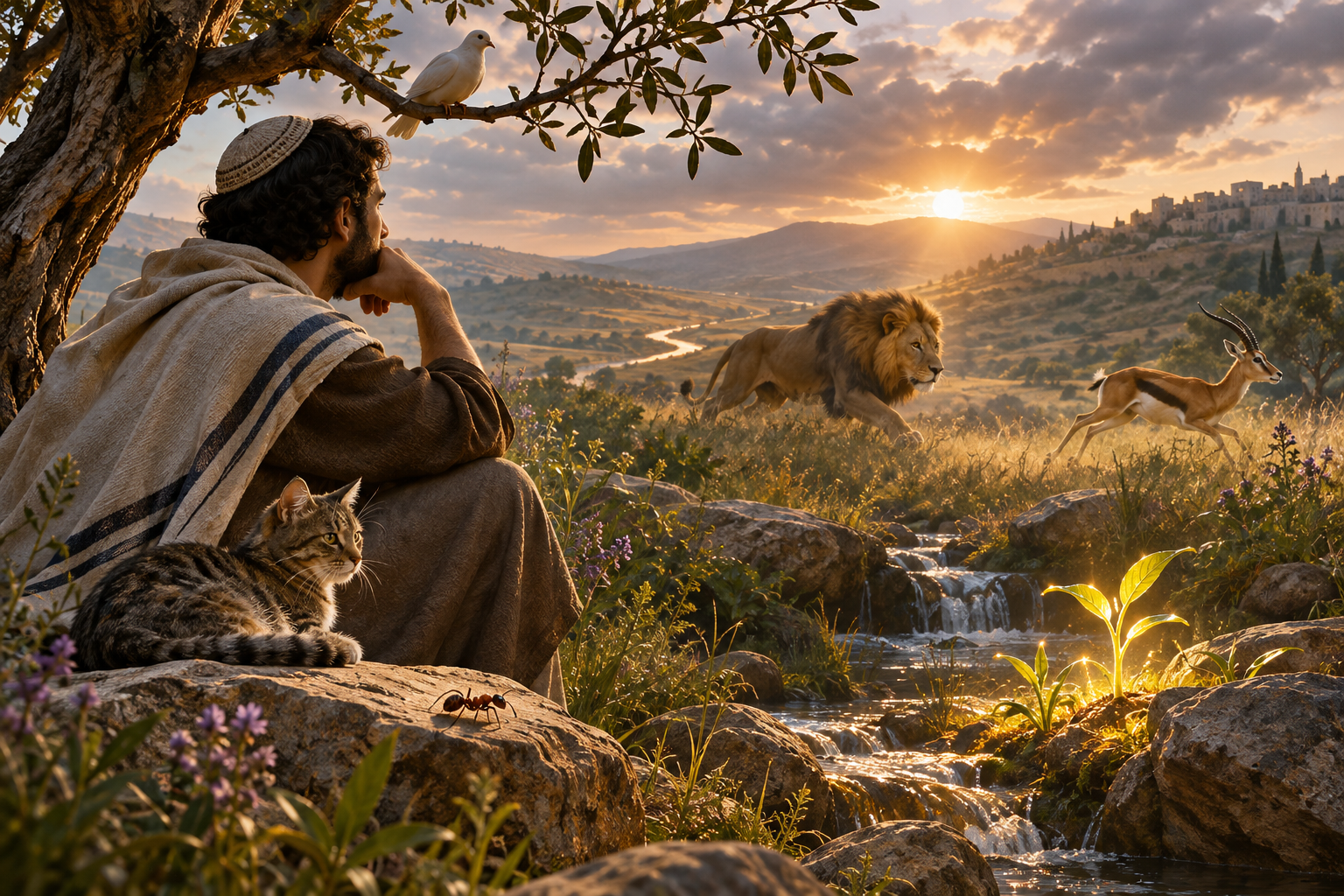
A lion attacks a gazelle. The gazelle struggles to escape. If the lion succeeds, one animal survives by taking another’s life.
We see pain, fear, violence, and sometimes prolonged suffering. Elsewhere, we see animals protecting their young, cooperating, sharing resources, or quietly grazing.
Why did Hashem create an animal world with such different forms of behavior? And why should human beings pay attention to them?
Chazal offer a remarkable starting point.
Chazal Teach Us to Learn Middot from Animals
The Gemara in Eruvin 100b teaches:
אמר רבי יוחנן אילמלא לא ניתנה תורה היינו למידין צניעות מחתול וגזל מנמלה ועריות מיונה
Rabbi Yochanan said: Had the Torah not been given, we would have learned modesty from the cat, avoidance of theft from the ant, and restraint in relations from the dove.
Think about that. Rabbi Yochanan is telling us that the animal world itself contains lessons about how human beings should behave.
The cat does not study the laws of tzeniut. The ant doesn’t learn Choshen Mishpat, the laws governing property and theft. Their behavior reflects the nature Hashem gave them. Yet we can observe it, understand something about ourselves, and choose to act accordingly.
Pirkei Avot 5:20 takes this further:
הוי עז כנמר וקל כנשר ורץ כצבי וגבור כארי לעשות רצון אביך שבשמים
Be bold like a leopard, light like an eagle, swift like a deer, and strong like a lion in doing the will of your Father in Heaven.
Notice what the Mishnah is asking us to do. It isn’t telling us to abandon our animal-like qualities. It tells us to recognize them and use them for avodat Hashem.
The lion’s strength is not inherently sinful. Neither is the leopard’s boldness. The question is what a human being chooses to do with those powers.
The Animal World Shows Us the Full Range of Our כוחות
Hunger, fear, strength, aggression, cooperation, desire, self-preservation, protection of offspring—these are among the כוחות Hashem built into living creatures.
We possess many of the same powers.
But there is something particularly revealing about observing animals: we get to see those powers operating without the same moral responsibility that Hashem places upon human beings.
Sometimes what we see is admirable. An animal protects its young, works with others, or persists against extraordinary difficulties.
Sometimes it is disturbing.
A predator may pursue and kill its prey. Animals fight over territory or access to mates. The vulnerable may suffer terrible injuries, and the struggle to survive can end in violent death.
This suffering is real. It is not something we need to explain away to appreciate the lesson.
Yet the predator is not committing murder. It is acting according to its nature, and predation itself can serve important purposes within the natural order.
The animal world reveals what our כוחות can do. Torah gives us the responsibility to decide what they should do.
The distinction is not that animals have natural drives while humans don’t. Nor is it that animals are incapable of learning or restraining their behavior.
It is that humans are accountable for how they exercise their powers. We can examine our desires, recognize their consequences, and decide whether acting upon them is right.
And we possess another power that makes the choice more complicated: our ability to reason.
Why Does Humanity’s First Moral Test Concern Eating?
Rav Noach Weinberg z”l would ask:
Are you eating to live, or living to eat?
Perhaps this question takes us back to Gan Eden.
Hashem gave Adam and Chava a garden filled with food. Nearly everything was theirs to enjoy. Just one tree was forbidden.
Why did the first test of human obedience concern eating?
Food is unavoidable. We need it to live. It engages our senses, appetite, pleasure, judgment, and intelligence. And because we eat several times every day, the relationship between our desires and our decisions is constantly tested.
But the Torah’s description of Chava’s decision contains something particularly important.
ותרא האשה כי טוב העץ למאכל וכי תאוה הוא לעינים ונחמד העץ להשכיל
The woman saw that the tree was good for food, desirable to the eyes, and attractive as a means of gaining understanding. (Bereishit 3:6)
The tree appealed not only to appetite and sight, but also to the intellect: ונחמד העץ להשכיל.
The serpent had already supplied an argument for eating from the forbidden tree. The temptation was no longer merely about satisfying a desire. It came accompanied by a justification.
When Our Intelligence Begins Serving Our Desires
The Malbim, commenting on Bereishit 3:6, develops precisely this danger.
He distinguishes between a person’s intellect guiding desire and desire recruiting the intellect to serve it:
כי השכל כשיקדם אל התאוה הוא טוב
When the intellect precedes desire, it is good.
But when desire comes first, the Malbim explains, it calls upon the intellect to help fulfill its wishes, inventing justifications and excuses.
ואז תקרא התאוה את השכל לעזר לה
Then desire calls upon the intellect to help it.
This is a profound description of a distinctly human danger.
An animal may pursue food because it is hungry. Human beings can pursue something because they want it—and then use their intelligence to convince themselves that obtaining it is justified.
We can reason our way toward truth.
Or we can use our reasoning powers to defend what we already want to believe.
The first problem is not that we possess an appetite. Hashem Himself provided Adam and Chava with food.
The problem is what happens when our כוחות stop serving truth, and our intellect starts serving our כוחות.
Cain and Hevel Show How Far This Can Go
The very next story in the Torah reveals how serious the consequences can become.
Cain and Hevel bring offerings to Hashem. Cain brings from the produce of the land; Hevel brings from his flock.
When Cain’s offering is not accepted, he becomes angry.
Hashem warns him:
לפתח חטאת רבץ ואליך תשוקתו ואתה תמשל בו
Sin is crouching at the entrance. Its desire is toward you, but you can master it. (Bereishit 4:7)
The Gemara in Kiddushin 30b applies this warning to humanity’s ongoing struggle with the yetzer hara, our inclination toward wrongdoing.
Cain’s anger is real. So is his ability—and responsibility—to master it.
But Cain kills Hevel.
Think about the contrast with the animal world.
A lion may kill a gazelle to obtain nourishment. Cain kills his brother even though his survival does not require it.
An animal can destroy life without committing a moral wrong. A human being can destroy life while possessing the capacity to understand that the act is wrong.
And the consequences are devastating.
Perhaps this is among the important things we are meant to recognize when we see the pain, suffering, violence, and struggle of the animal world.
We see what powerful natural drives can bring about. We also see what is at stake when human beings, who possess moral responsibility, fail to govern their own.
The suffering of prey isn’t incidental to what we observe. It makes the consequences of power visible.
But that is not the same as claiming that Hashem created animal suffering solely to instruct us. We have not established that, and the broader question of why suffering exists remains.
Even the Yetzer Hara Is Part of טוב מאד
One might conclude that our natural desires are the problem, and that the ideal human being would somehow rise above them entirely.
But Chazal teach something quite different.
Bereishit Rabbah 9:7 offers a surprising explanation of the Torah’s description of creation as טוב מאד:
והנה טוב מאד זה יצר טוב והנה טוב מאד זה יצר רע
“And behold, it was very good”—this refers to the good inclination; “and behold, it was very good”—this also refers to the evil inclination.
The Midrash asks:
וכי יצר הרע טוב מאד
Is the evil inclination really very good?
And answers:
אלא שאלולי יצר הרע לא בנה אדם בית ולא נשא אשה ולא הוליד ולא נשא ונתן
Without the evil inclination, a person would not build a house, marry, have children, or engage in commerce.
Our natural drives are not an unfortunate obstacle to being human. They are part of what makes human life, achievement, and growth possible.
Ambition can build businesses and provide livelihoods. The same ambition can lead to exploitation.
Strength can protect the vulnerable or overpower them.
Intelligence can uncover truth or construct elaborate arguments for wrongdoing.
The challenge is not to eliminate these powers, but to master them and direct them toward what is right.
That is exactly what Pirkei Avot teaches when it tells us to be strong like a lion לעשות רצון אביך שבשמים—to do the will of our Father in Heaven.
Perhaps We Should Ask Why Hashem Created Animals
This brings us back to our original question.
Why did Hashem create an animal world in which creatures consume other living things, sometimes violently?
Perhaps we have been asking the question too narrowly.
Rather than treating predation as an isolated feature of creation, consider the animal world as a whole.
It displays an extraordinary range of כוחות and behaviors. Some creatures hunt, others graze. Some compete, others cooperate. There is courage and fear, care and aggression, vulnerability and strength.
It is a world that can inspire admiration and, at times, horror.
Chazal tell us to study this world and learn from it.
Perhaps, then, one important purpose of the animal world is to reveal the powers Hashem built into life—including powers that operate within ourselves.
Predation is one part of that picture. It makes the destructive potential of competing needs and natural drives especially vivid.
But the lesson extends far beyond predation.
The animal world helps us recognize what we are capable of. The Torah teaches us how to choose what we ought to become.
This is a proposed explanation for what the animal world reveals to human beings. It does not prove that moral education is the reason predation exists, nor does it fully answer why every living organism must obtain nourishment in the way it does.
אמת מארץ תצמח — Truth Must Grow from the Earth
Bereishit Rabbah 8:5 tells us that when Hashem was about to create Adam, the angels disagreed.
Chesed and Tzedek favored creation because human beings would perform kindness and righteousness. Emet and Shalom opposed it because human beings would be dishonest and quarrelsome.
What did Hashem do?
נטל אמת והשליכו לארץ
He took Truth and cast it to the earth.
The Midrash invokes the words of Tehillim 85:12:
אמת מארץ תצמח
Truth will grow from the earth.
Perhaps this helps us understand the larger purpose of our struggle.
Hashem placed us in a physical world filled with life, power, desire, fear, competition, and cooperation.
We belong to that world. We have bodies that hunger, hearts that desire, and minds capable of reasoning.
But unlike the animals from which we learn, we are responsible for deciding how those powers will be used.
Will our strength protect or dominate? Will our ambition build or exploit? Will our intelligence discover truth or rationalize desire?
This is not about becoming less physical.
It’s about becoming more fully human.
The animal world reveals what our כוחות can do. Torah gives us the responsibility to decide what they should do.
And perhaps that is one way אמת מארץ תצמח: truth grows when human beings take the powers Hashem placed within physical life and consciously direct them toward what is right.
Sources and Further Reading
- Eruvin 100b — Rabbi Yochanan on learning middot from animals.
- Pirkei Avot 5:20 — Directing animal qualities toward avodat Hashem.
- Derekh Chayyim on Avot 5:20 — The Maharal’s commentary on the Mishnah.
- Bereishit 2–4 — Gan Eden, the serpent, and Cain and Hevel.
- Malbim on Bereishit 3:6 — The intellect serving desire rather than governing it.
- Kiddushin 30b — The yetzer hara and Hashem’s warning to Cain.
- Bereishit Rabbah 9:7 — The constructive role of the yetzer hara.
- Bereishit Rabbah 8:5 — Truth cast down to earth.
- Tehillim 85:12 — אמת מארץ תצמח.